Be yourself; Everyone else is already taken.
— Oscar Wilde.
This is the first post on my new blog. I’m just getting this new blog going, so stay tuned for more. Subscribe below to get notified when I post new updates.
Worldmusic
Be yourself; Everyone else is already taken.
— Oscar Wilde.
This is the first post on my new blog. I’m just getting this new blog going, so stay tuned for more. Subscribe below to get notified when I post new updates.
See also: List of percussion instrumentsMain article: List of idiophones by Hornbostel–Sachs number
| Instrument | Photo | Classification | H-S Number | Origin | Common classification | Relation |
|---|---|---|---|---|---|---|
| Agung a Tamlang | idiophones | 111.24 | Philippines | unpitched percussion | slit drum | |
| Bamboo slit drum | idiophones | Africa,[1] Asia[2] | unpitched percussion | slit drum | ||
| Balafon | idiophones | 111.212 | Africa | pitched percussion | keyboard | |
| Cajón | idiophones | 111.2 | Peru | unpitched percussion | box drum | |
| Castanets | idiophones | 111.141 | Spain | unpitched percussion | ||
| Clapsticks/Clave sticks | idiophones | 111.11 | Australia | unpitched percussion | clave sticks | |
| Cymbal | idiophones | Romania | ||||
| Octa-Vibraphone | idiophones | United States | percussion | keyboard | ||
| Glockenspiel | idiophones | 111.212 | France/Germany | percussion | keyboard | |
| Handpan | idiophones | 111.24 | pitched percussion | steelpan | ||
| Marimba | idiophones | 111.212 | Guatemala, Africa, Mexico, Honduras, Nicaragua, & Costa Rica | pitched percussion | keyboard | |
| Mbira | idiophones | 111.212 | Africa | pitched percussion | keyboard | |
| Steelpan | idiophones | 111.24 | Trinidad & Tobago | pitched percussion | steelpan | |
| Triangle | idiophones | 111.2 | unpitched percussion | triangle | ||
| Vibraphone | idiophones | 111.222 | pitched percussion | keyboard | ||
| Wood block | idiophones | 111.2 | unpitched percussion | drum | ||
| Xylophone | idiophones | 111.2 |
Music comes in many different types and styles ranging from traditional rock music to world pop, easy listening and bluegrass. Many genres have a rich history or geographical significance, a cult following or music roots that go far beyond the 20th century.
The Music Genres List site covers many of the most popular styles of music, the site is becoming the definitive list of music genres on the Internet – thanks to you – and if you feel any music genres are missing (we’re sure there are many!) please send an email to add @ musicgenreslist dot com and we’ll add to get closer to completing the music list of genres.
And a big thank you to the folks who have already sent in suggestions. We haven’t added them all as some are not easily verified or differentiated from our current list (and we get many music genres suggestions that are duplicates), however all the genres we can research and confirm as valid or derivatives or existing genres or music types, we’ve added and have attributed by way of thanks.
Keep them coming! Take me to the list of music genres below!
Classical music is art music produced or rooted in the traditions of Western culture, including both liturgical (religious) and secular music. While a more precise term is also used to refer to the period from 1750 to 1820 (the Classical period), this article is about the broad span of time from before the 6th century AD to the present day, which includes the Classical period and various other periods.[1] The central norms of this tradition became codified between 1550 and 1900, which is known as the common-practice period.
Western music is a form of country and hillbilly music composed by and about the people who settled and worked throughout the Western United States and Western Canada. Western music celebrates the life of the cowboy on the open ranges, Rocky Mountains, and prairies of Western North America. Directly related musically to old English, Irish, Scottish, and folkballads, also the Mexican folk music of Northern Mexico and Southwestern United States influenced the development of this genre, particularly corrido, ranchera, New Mexico and Tejano. Western music shares similar roots with Appalachian music (also called country or hillbilly music), which developed around the same time throughout Appalachia and the Appalachian Mountains. The music industry of the mid-20th century grouped the two genres together under the banner of country and western music, later amalgamated into the modern name, country music.
Prehistoric music can only be theorized based on findings from paleolithic archaeology sites. Flutes are often discovered, carved from bones in which lateral holes have been pierced; these are thought to have been blown at one end like the Japanese shakuhachi. The Divje Babe flute, carved from a cave bear femur, is thought to be at least 40,000 years old. Instruments such as the seven-holed flute and various types of stringed instruments, such as the Ravanahatha, have been recovered from the Indus Valley Civilization archaeologicalsites.[29] India has one of the oldest musical traditions in the world—references to Indian classical music (marga) are found in the Vedas, ancient scriptures of the Hindu tradition.[30] The earliest and largest collection of prehistoric musical instruments was found in China and dates back to between 7000 and 6600 BC.[31] The “Hurrian Hymn to Nikkal“, found on clay tablets that date back to approximately 1400 BC, is the oldest surviving notated work of music.[32][33]
Main article: Music of Egypt

Musicians of Amun, Tomb of Nakht, 18th Dynasty, Western Thebes
The ancient Egyptians credited one of their gods, Thoth, with the invention of music, with Osiris in turn used as part of his effort to civilize the world. The earliest material and representational evidence of Egyptian musical instruments dates to the Predynastic period, but the evidence is more securely attested in the Old Kingdom when harps, flutes and double clarinets were played.[34] Percussion instruments, lyres and lutes were added to orchestras by the Middle Kingdom. Cymbals[35] frequently accompanied music and dance, much as they still do in Egypt today. Egyptian folk music, including the traditional Sufi dhikr rituals, are the closest contemporary music genre to ancient Egyptian music, having preserved many of its features, rhythms and instruments.[36][37]

Indian women dressed in regional attire playing a variety of musical instruments popular in different parts of India
| Gangubai Hangal Durga |
|---|
See also: Music of Iran, Music of Afghanistan, Music of Tajikistan, Music of Sri Lanka, and Music of Uzbekistan
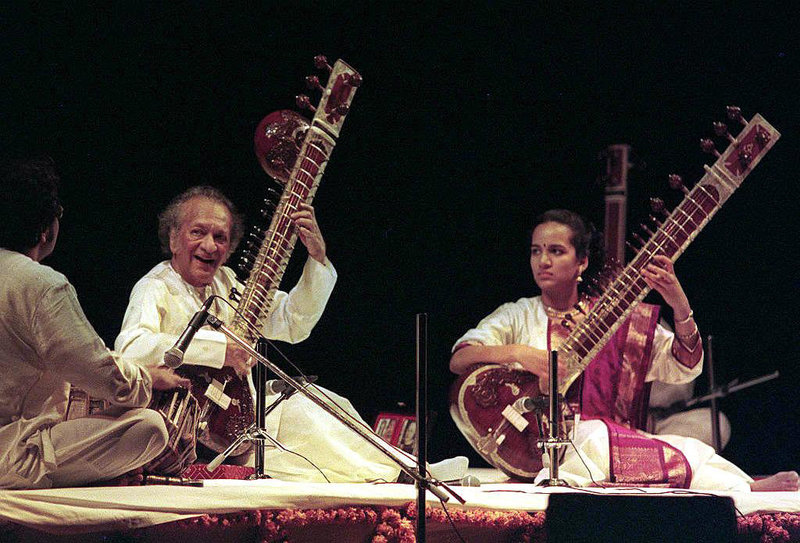
Indian classical music is one of the oldest musical traditions in the world.[38] The Indus Valley civilization has sculptures that show dance[39] and old musical instruments, like the seven holed flute. Various types of stringed instruments and drums have been recovered from Harappa and Mohenjo Daro by excavations carried out by Sir Mortimer Wheeler.[40] The Rigveda has elements of present Indian music, with a musical notation to denote the metre and the mode of chanting.[41] Indian classical music (marga) is monophonic, and based on a single melody line or raga rhythmically organized through talas. Silappadhikaram by Ilango Adigal provides information about how new scales can be formed by modal shifting of the tonic from an existing scale.[42] Hindi music was influenced by the Persian performance practices of the Afghan Mughals. Carnatic music, popular in the southern states, is largely devotional; the majority of the songs are addressed to the Hindu deities. There are also many songs emphasising love and other social issues.
Asian music covers the music cultures of Arabia, Central Asia, East Asia, South Asia, and Southeast Asia. Chinese classical music, the traditional art or court music of China, has a history stretching over around three thousand years. It has its own unique systems of musical notation, as well as musical tuning and pitch, musical instruments and styles or musical genres. Chinese music is pentatonic-diatonic, having a scale of twelve notes to an octave (5 + 7 = 12) as does European-influenced music. Persian music is the music of Persia and Persian language countries: musiqi, the science and art of music, and muzik, the sound and performance of music (Sakata 1983).
Main article: History of music in the biblical period

“David with his harp” Paris Psalter,
c. 960, Constantinople
Music and theatre scholars studying the history and anthropology of Semitic and early Judeo-Christian culture have discovered common links in theatrical and musical activity between the classical cultures of the Hebrews and those of later Greeks and Romans. The common area of performance is found in a “social phenomenon called litany,” a form of prayer consisting of a series of invocations or supplications. The Journal of Religion and Theatre notes that among the earliest forms of litany, “Hebrew litany was accompanied by a rich musical tradition:”[43]“While Genesis 4.21 identifies Jubal as the “father of all such as handle the harp and pipe,” the Pentateuch is nearly silent about the practice and instruction of music in the early life of Israel. Then, in I Samuel 10 and the texts that follow, a curious thing happens. “One finds in the biblical text,” writes Alfred Sendrey, “a sudden and unexplained upsurge of large choirs and orchestras, consisting of thoroughly organized and trained musical groups, which would be virtually inconceivable without lengthy, methodical preparation.” This has led some scholars to believe that the prophet Samuel was the patriarch of a school, which taught not only prophets and holy men, but also sacred-rite musicians. This public music school, perhaps the earliest in recorded history, was not restricted to a priestly class—which is how the shepherd boy David appears on the scene as a minstrel to King Saul.”[43]
| Epitaph of SeikilosMelody sung in an approximation of Koine Greek pronunciation and in modern popular vocal style. |
| Problems playing this file? See media help. |
Music was an important part of social and cultural life in ancient Greece. Musicians and singers played a prominent role in Greek theater.[44] Mixed-gender choruses performed for entertainment, celebration, and spiritual ceremonies.[45] Instruments included the double-reed aulos and a plucked string instrument, the lyre, principally the special kind called a kithara. Music was an important part of education, and boys were taught music starting at age six. Greek musical literacy created a flowering of music development. Greek music theory included the Greek musical modes, that eventually became the basis for Western religious and classical music. Later, influences from the Roman Empire, Eastern Europe, and the Byzantine Empire changed Greek music. The Seikilos epitaph is the oldest surviving example of a complete musical composition, including musical notation, from anywhere in the world.[46] The oldest surviving work written on the subject of music theory is Harmonika Stoicheia by Aristoxenus.[47]
| Léonin or Pérotin Breves dies hominis |
|---|

Musical notation from a Catholic Missal, c. 1310–1320
The medieval era (476 to 1400), which took place during the Middle Ages, started with the introduction of monophonic (single melodic line) chanting into Roman Catholic Church services. Musical notationwas used since Ancient times in Greek culture, but in the Middle Ages, notation was first introduced by the Catholic church so that the chant melodies could be written down, to facilitate the use of the same melodies for religious music across the entire Catholic empire. The only European Medieval repertory that has been found in written form from before 800 is the monophonic liturgical plainsong chant of the Roman Catholic Church, the central tradition of which was called Gregorian chant. Alongside these traditions of sacred and church music there existed a vibrant tradition of secular song (non-religious songs). Examples of composers from this period are Léonin, Pérotin, Guillaume de Machaut, and Walther von der Vogelweide.
This is an example post, originally published as part of Blogging University. Enroll in one of our ten programs, and start your blog right.
You’re going to publish a post today. Don’t worry about how your blog looks. Don’t worry if you haven’t given it a name yet, or you’re feeling overwhelmed. Just click the “New Post” button, and tell us why you’re here.
Why do this?
The post can be short or long, a personal intro to your life or a bloggy mission statement, a manifesto for the future or a simple outline of your the types of things you hope to publish.
To help you get started, here are a few questions:
You’re not locked into any of this; one of the wonderful things about blogs is how they constantly evolve as we learn, grow, and interact with one another — but it’s good to know where and why you started, and articulating your goals may just give you a few other post ideas.
Can’t think how to get started? Just write the first thing that pops into your head. Anne Lamott, author of a book on writing we love, says that you need to give yourself permission to write a “crappy first draft”. Anne makes a great point — just start writing, and worry about editing it later.
When you’re ready to publish, give your post three to five tags that describe your blog’s focus — writing, photography, fiction, parenting, food, cars, movies, sports, whatever. These tags will help others who care about your topics find you in the Reader. Make sure one of the tags is “zerotohero,” so other new bloggers can find you, too.

 World Music


